

1. Quality — Craftsmanship, Technology & Consistency
Why China is not a downgrade in quality, but very often an upgrade.
Southern China — particularly Shenzhen — has become a global hub for premium illustrated and children’s publishing. Export-focused factories run modern Heidelberg and Komori presses, calibrated with ISO and G7 color standards, producing sharp text, smooth gradients, and vibrant CMYK images on a daily basis.
Chinese printers shine in book categories that require both technical precision and hand craftsmanship. Typical examples include:
- Full-color children’s board books, novelty formats, lift-the-flap and pop-up books
- Smyth-sewn hardcovers and premium casebound editions with headbands and ribbon markers
- Lay-flat bindings and gallery-quality photo and art monographs
- High-spec coffee-table books with multiple finishes and special effects
- Multi-component box sets combining books, cards, inserts, and custom packaging
Finishing processes that are often considered “specialty” or “expensive extras” in other regions — such as foil stamping, spot UV, blind embossing and debossing, soft-touch or matte films, lenticular covers, and intricate die-cutting — are commonplace in China. Because expertise, equipment, and volume are concentrated, these finishes are not only more accessible, but also more consistent in quality.
Shenzhen adds another advantage: a dense ecosystem of paper merchants, binderies, finishing houses, and packaging suppliers within a compact radius. This clustering lets manufacturers like ChinaBestPrinting monitor each stage of production in real time, catch issues early, and ensure smooth handoffs between steps. That translates into fewer surprises and more predictable quality.
For premium illustrated, children’s, and art books, choosing China is rarely a compromise — it is often the best way to achieve the quality you truly want.
2. Cost — Total Unit Economics & Margin Protection
How China still delivers powerful economic advantages, even with higher global freight.
Cost is usually the first reason publishers look to China — and it remains a strong one. While global freight rates and wages have increased, China’s economics are driven less by “cheap labor” and more by scale, specialization, and integrated supply chains. For many full-color projects, especially in medium and larger print runs, the total unit cost remains significantly lower than in North America or Western Europe.
For 4-color illustrated books in the 3,000–5,000+ copy range, it is still common to see manufacturing savings in the range of 35–55% compared with Western production.
A simplified example helps illustrate the point. Consider a 200–240 page, 8.5″ × 11″ full-color hardcover with Smyth-sewn binding and a dust jacket, printed at 5,000 copies:
| Region | Approx. Unit Manufacturing Cost | Notes |
|---|---|---|
| North America | > $8.50 | Higher labor and finishing premiums |
| Western Europe | > $9.50 | Strong quality, higher overhead |
| China (Shenzhen) | < $6.50 | ~35–50% lower manufacturing cost |
Once freight, insurance, and port fees are added, landed costs from China naturally rise. However, books are generally duty-free in markets such as the United States, and experienced freight forwarders consolidate shipments to reduce per-unit transport costs. In many projects, even after all logistics are included, the total landed unit cost from China is still significantly below domestic manufacturing — especially when high-end finishing is involved.
Those savings can be redirected into several strategic areas:
- Strengthening gross margins in price-sensitive categories
- Upgrading paper stocks, bindings, or finishes without losing profitability
- Improving retail price positioning against competitors
- Providing a buffer against future freight, currency, or material volatility
China allows publishers to deliver more book for the money — better physical products at prices readers and retailers will still accept.
3. Schedule — Lead Times, Logistics & Supply-Chain Control
Why modern workflows make overseas schedules workable — and often predictable.
Historically, longer lead times were seen as the main drawback of printing in Asia. Domestic printers could sometimes deliver within four to six weeks, while overseas projects might require ten to twelve. However, digital proofing, faster communication, and more frequent sailings have narrowed that gap considerably.
A typical China-based schedule for a full-color book might include:
- Digital proofing and approvals: 5–10 days
- Printing and binding: 3–4 weeks, depending on complexity
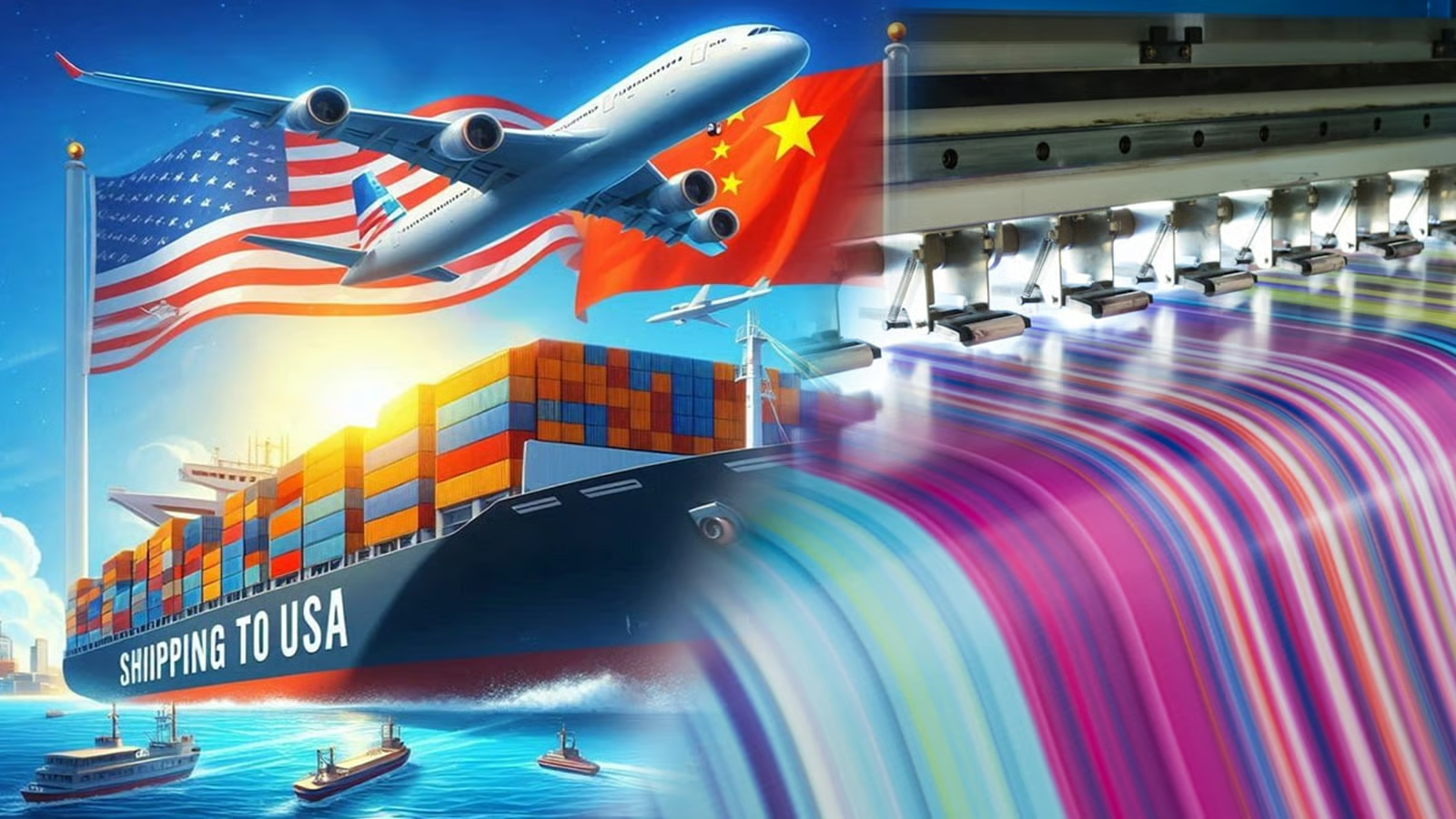
- Ocean freight from Shenzhen: ~14–16 days to the U.S. West Coast, 20–26 days to the East Coast, and ~24–30 days to Europe
These stages can be overlapped with other projects, and for established titles publishers can plan reprints in advance, reducing the risk of out-of-stock gaps. When needed, partial shipments can be sent by air while the balance travels by sea, ensuring that key markets receive stock in time for major promotions or seasonal peaks.
Shenzhen’s location next to Hong Kong is a major advantage. It provides access to one of the world’s busiest container ports and an international air hub, resulting in frequent sailings and flexible routing options. This is particularly valuable when multiple destinations — for example, North America, Europe, and Asia-Pacific — must all receive stock in a coordinated window.
With realistic planning and the right partner, schedules from China are not a liability — they are a manageable part of a lean, global supply chain.